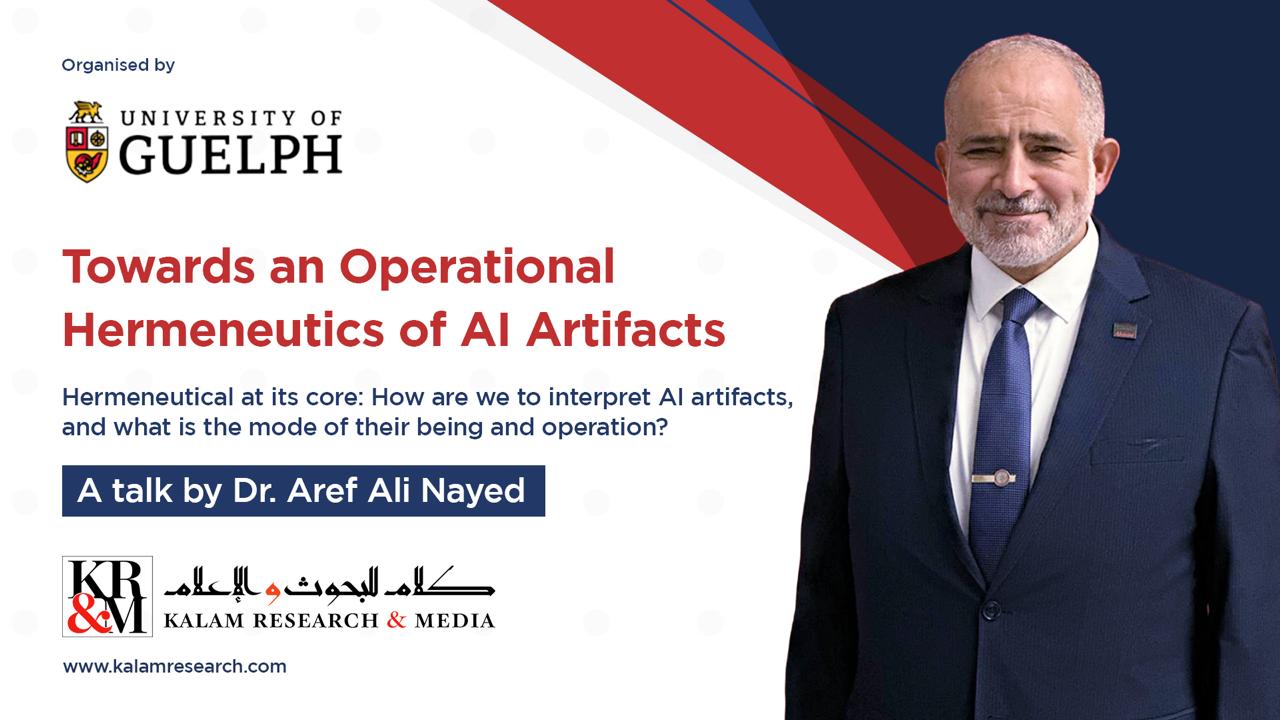
Dr. Aref Ali Nayed, Chairman of Kalam Research & Media, delivered a lecture at the University of Guelph exploring the intersection of hermeneutics, artificial intelligence, and ethical governance of emerging technologies.
About the Lecture
The presentation examined how Operational Hermeneutics—a framework Dr. Nayed developed in the 1990s at the University of Guelph—provides essential tools for understanding and ethically engaging with AI-generated artifacts. Dr. Nayed discussed how AI systems function as operational artifacts that interpret, generate meaning, and shape human understanding.
Key topics included:
- The application of Operational Hermeneutics to artificial intelligence
- Ethical frameworks for AI interpretation and engagement
- The role of presuppositional structures in AI design
- Hermeneutical responsibility in the age of generative AI
- Collaboration between philosophical inquiry and technological innovation
Watch the Full Lecture
Related Initiatives
This lecture was part of Dr. Nayed’s broader engagement with the Centre for Advancing Responsible and Ethical Artificial Intelligence (CARE-AI) at the University of Guelph. The visit strengthened ongoing collaboration between KRM and Canadian AI research institutions focused on developing ethical frameworks for artificial intelligence.
Read more about Dr. Nayed’s visit to CARE-AI →
Further Reading
Dr. Nayed has recently published a comprehensive academic paper expanding on themes addressed in this lecture:
“Towards an Operational Hermeneutics of AI Artifacts” examines how AI-generated outputs can be understood as operational artifacts requiring hermeneutical engagement. The paper proposes new frameworks for interpreting machine-generated content and addresses the ethical dimensions of human-AI interaction.
About the University of Guelph Partnership
The University of Guelph holds special significance in Dr. Nayed’s intellectual journey—it was here in the 1990s that he developed the foundational concepts of Operational Hermeneutics during his doctoral research. His return to Guelph represents a homecoming of ideas, bringing decades of refinement back to their birthplace now applied to contemporary challenges in AI ethics.
KRM’s partnership with the University of Guelph and CARE-AI forms part of a broader network of collaborations with leading Canadian AI institutions, including the Vector Institute for Artificial Intelligence and the Canadian Institute for Advanced Research (CIFAR).
KRM’s Artificial Understanding Research
Unlike conventional AI research focused on machine performance, KRM has pioneered research in Artificial Understanding (AU)—a distinctive approach that asks fundamental questions about comprehension, meaning, and interpretation in artificial systems.
The AU research program, grounded in Operational Hermeneutics, pursues three aims:
- To truly understand operational artifacts (machines)
- To build operational artifacts that can understand
- To build tools that support humans as they strive to understand each other
Learn more about KRM’s Artificial Understanding program →
Related Articles:
- Dr. Nayed Visits Centre for Advancing Responsible AI at University of Guelph
- Towards an Operational Hermeneutics of AI Artifacts
- KRM to Develop New Research on Artificial Understanding (AU)